Running a successful restaurant requires more than serving great food. Restaurant owners must understand their costs, price their menu correctly, manage inventory, and maintain consistent food quality while protecting profitability.
One of the most important financial metrics to track is restaurant food cost percentage. It helps you understand how much of your food sales is spent on ingredients and whether your purchasing, portion sizes, menu prices, and inventory practices are supporting your business goals.
In this guide, Growth Authority explains how to calculate food cost percentage, understand ideal food cost benchmarks, identify common mistakes, and implement practical strategies to improve restaurant profitability.
What Is Restaurant Food Cost Percentage?
Restaurant food cost percentage is the proportion of food sales spent on the ingredients used to prepare the food sold during a specific period.
For example, if your restaurant generates $10,000 in food sales and spends $3,000 on the food ingredients associated with those sales, your food cost percentage is 30%.
Monitoring this metric helps restaurant owners evaluate menu pricing, purchasing decisions, portion control, inventory management, and overall financial performance.
However, food cost percentage should not be considered in isolation. Labor, rent, utilities, delivery commissions, marketing, and other operating expenses also affect a restaurant's profitability.
How to Calculate Restaurant Food Cost Percentage
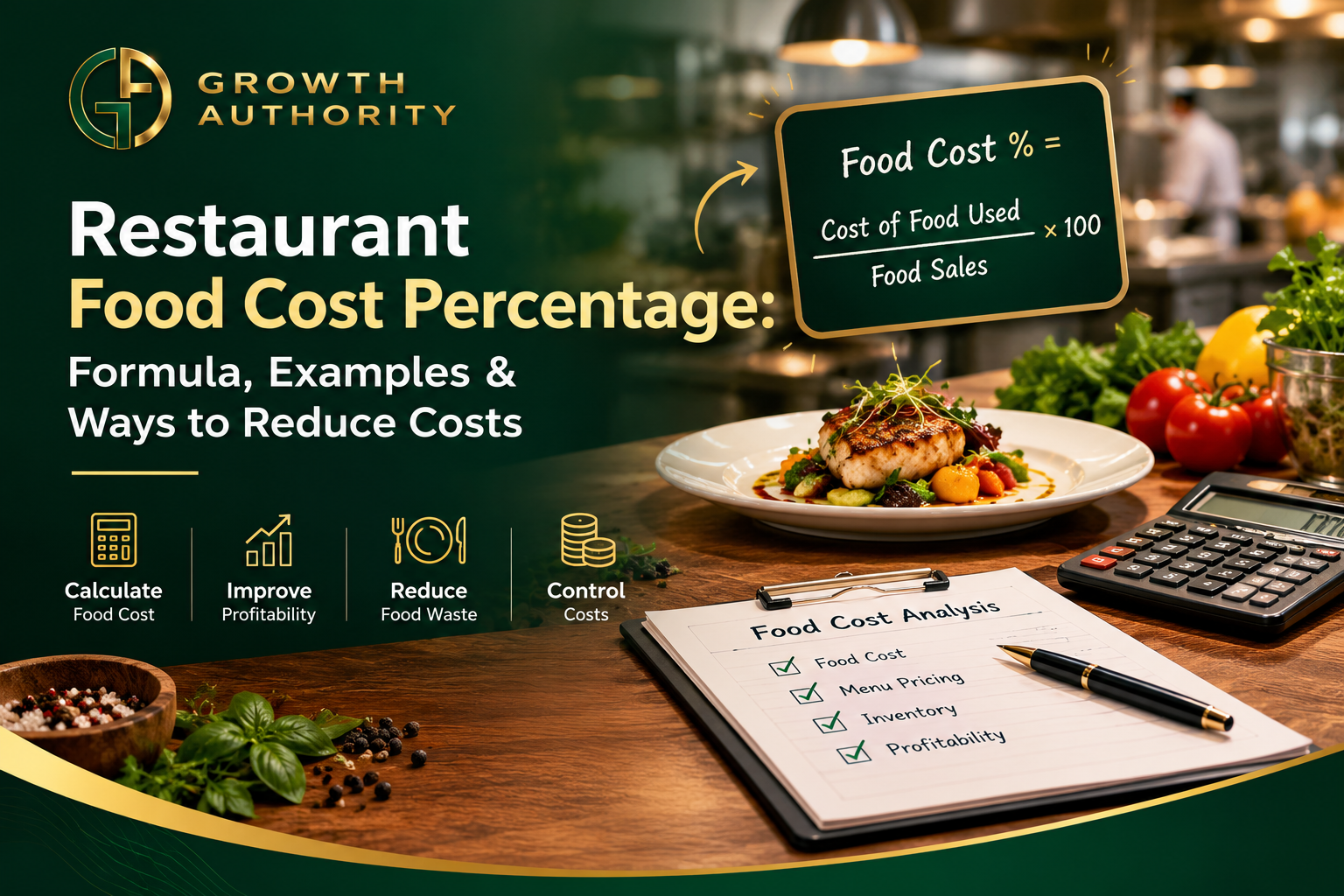
The basic formula is:
Food Cost Percentage = (Cost of Food Used ÷ Food Sales) × 100
To calculate this accurately, you need three key figures:
-
Beginning inventory: The value of food inventory at the start of the period.
-
Purchases: The cost of additional food ingredients purchased during that period.
-
Ending inventory: The value of remaining food inventory at the end of the period.
First, calculate the cost of food used:
Cost of Food Used = Beginning Inventory + Purchases − Ending Inventory
Then calculate the food cost percentage:
Food Cost Percentage = (Cost of Food Used ÷ Food Sales) × 100
This approach is more useful than simply dividing purchases by sales because ingredients purchased during one period may remain in inventory and be used later.
For the calculation to be meaningful, inventory values, purchases, and sales should cover the same period and use consistent accounting methods.
Restaurant Food Cost Percentage: Example Calculation
Consider a restaurant with the following monthly figures.
| Financial item | Amount |
|---|---|
| Beginning food inventory | $4,000 |
| Food purchases during the month | $8,000 |
| Ending food inventory | $3,000 |
| Food sales | $30,000 |
Step 1: Calculate the cost of food used.
$4,000 + $8,000 − $3,000 = $9,000
Step 2: Calculate food cost percentage.
($9,000 ÷ $30,000) × 100 = 30%
This means the restaurant used $0.30 worth of food ingredients for every $1 in food sales during the period.
The remaining $0.70 is not net profit. It must still cover other expenses, including labor, rent, utilities, insurance, and other operating costs.
Understanding this distinction is essential when evaluating restaurant financial performance.
What Is a Good Food Cost Percentage for a Restaurant?
There is no single ideal food cost percentage for every restaurant. The appropriate target depends on the restaurant's concept, menu, ingredient quality, pricing strategy, service model, and operating expenses.
For illustration, a restaurant might use the following internal planning ranges:
| Restaurant concept | Illustrative food cost target |
|---|---|
| Quick-service restaurant | 25%–32% |
| Casual dining restaurant | 28%–35% |
| Fine dining restaurant | 30%–38% |
| Pizza restaurant | 20%–30% |
| Bakery or café | 25%–35% |
These are illustrative planning ranges, not verified industry averages or universal standards. Actual results vary by business, product mix, market, and accounting method.
Instead of adopting a benchmark without context, restaurant owners should establish targets using their actual ingredient costs, menu prices, historical performance, and overall profitability requirements.
A restaurant with a 32% food cost is not necessarily less profitable than one operating at 27%. The first may have higher menu prices, stronger sales, lower labor costs, or a more favorable overall expense structure.
The key is to understand how food cost contributes to the restaurant's complete financial picture.
Food Cost Percentage vs. Ideal Food Cost Percentage
Restaurant operators should distinguish between actual food cost and ideal food cost.
Actual food cost measures the cost of food used relative to food sales over a specific period. It reflects real-world purchasing, inventory changes, waste, spoilage, portioning, and other operational factors.
Ideal food cost estimates the ingredient cost of the food sold based on standardized recipes, planned portions, and the actual sales mix.
For example, suppose the menu items sold during a week should have required $7,500 in ingredients according to standardized recipes. If the restaurant generated $25,000 in food sales, its ideal food cost percentage would be:
($7,500 ÷ $25,000) × 100 = 30%
If actual food cost is 34%, the four-percentage-point difference is a signal to investigate.
Possible explanations include excessive portions, food waste, inaccurate inventory counts, unrecorded spoilage, purchasing price increases, recipe inconsistencies, or errors in sales and inventory data.
The difference does not automatically mean that food has been stolen or wasted. Managers should investigate the underlying causes before taking corrective action.
Seven Ways to Reduce Restaurant Food Costs
Reducing food costs does not mean compromising ingredient quality or reducing portions indiscriminately. Sustainable improvement comes from better controls, informed purchasing, consistent preparation, and effective menu management.
1. Standardize Recipes and Portion Sizes
Every menu item should have a documented recipe with ingredient quantities, preparation instructions, and a defined serving size.
Use appropriate measuring tools, scales, portion scoops, and preparation guides to help kitchen staff maintain consistency.
Standardized recipes also make it easier to calculate ingredient costs and identify when supplier prices change.
2. Track Inventory Consistently
Perform regular inventory counts and compare actual stock with purchasing records and expected ingredient usage.
High-value ingredients and perishable products may require more frequent monitoring than shelf-stable items.
Investigate unexplained variances rather than relying on estimates. Accurate inventory data is essential for calculating food cost and making reliable purchasing decisions.
3. Reduce Food Waste and Spoilage
Track why food is being discarded. Common causes include overproduction, expired ingredients, improper storage, preparation errors, and returned dishes.
Practical steps include:
-
Using a first-in, first-out rotation system where appropriate.
-
Labeling ingredients with preparation or opening dates.
-
Monitoring refrigeration and storage conditions.
-
Preparing food in quantities aligned with demand.
-
Recording waste by ingredient, quantity, and reason.
Review waste records regularly to identify recurring problems and measure whether corrective actions work.
4. Review Supplier Prices and Purchasing Terms
Compare supplier prices, quality, delivery reliability, and purchasing terms rather than choosing suppliers solely on the lowest quoted price.
Review high-cost ingredients frequently and evaluate whether seasonal alternatives or appropriate ingredient substitutions can maintain quality while reducing costs.
For larger operations, consolidate purchasing where practical and negotiate terms based on reliable order volumes.
5. Improve Menu Engineering
Not every popular menu item contributes equally to profitability.
Calculate the ingredient cost and contribution margin of individual menu items.
Contribution Margin = Menu Selling Price − Ingredient Cost per Portion
For example, a dish selling for $18 with an ingredient cost of $5.40 has a contribution margin of $12.60 before labor and other operating expenses.
Review both contribution margin and sales popularity when deciding which dishes to promote, reprice, improve, or remove.
A menu item with a low food cost percentage may still generate less contribution margin than a higher-priced item with a larger ingredient cost.
6. Forecast Demand More Accurately
Use historical sales, seasonal patterns, reservations, local events, and day-of-week trends to estimate demand.
More accurate forecasting helps managers purchase appropriate quantities and prepare food in line with expected sales.
Forecasts should be updated as trading conditions change. Restaurant demand can vary substantially because of weather, holidays, promotions, and local competition.
7. Review Food Cost Performance Every Week
Monthly reports help measure overall performance, but weekly reviews can reveal operational problems sooner.
Track food cost percentage, ingredient price changes, waste, inventory variances, and sales mix. Investigate unusual changes and assign responsibility for corrective actions.
The objective is to build a repeatable management process, not merely to calculate a percentage at the end of the month.
Common Mistakes When Calculating Food Cost
Even experienced restaurant operators can make decisions based on inaccurate cost calculations.
Counting purchases instead of food used
Dividing all purchases by sales can distort the result when inventory increases or decreases significantly. Include beginning and ending inventory when calculating actual food cost.
Mixing food sales with unrelated revenue
Use a consistent sales definition. Food cost should generally be compared with the corresponding food sales, with discounts, refunds, taxes, and other items treated consistently in accordance with the restaurant's accounting approach.
Alcohol sales, for example, should not automatically be combined with food sales when calculating food cost percentage.
Ignoring waste and spoilage
Food discarded before being sold still has a financial impact. Actual food cost captures the effect of waste when inventory and usage are measured accurately, although separate waste tracking is needed to identify the causes.
Focusing only on the percentage
A lower food cost percentage does not always mean better financial performance. Excessive discounts, underpricing, or declining sales can affect the relationship between ingredient costs and revenue.
Evaluate food cost alongside sales volume, contribution margin, labor cost, and operating profit.
Using outdated ingredient costs
Supplier price changes can quickly make recipe cost calculations inaccurate. Update recipe costing when significant ingredient prices or portion specifications change.
How Restaurant Owners Can Build a Food Cost Control System
An effective food cost control system combines accurate financial reporting with daily operational discipline.
A practical starting point is to:
-
Calculate actual food cost weekly and monthly.
-
Maintain standardized recipes and updated ingredient costs.
-
Establish appropriate inventory-counting procedures.
-
Record food waste and investigate recurring causes.
-
Compare actual food cost with ideal food cost.
-
Review menu-item contribution margins.
-
Assign managers responsibility for monitoring results.
Restaurant groups should also standardize reporting across locations while allowing for legitimate differences in local supplier prices, menu offerings, and customer demand.
The goal is to make food cost management part of routine restaurant operations rather than an occasional accounting exercise.
When Should You Seek Restaurant Profitability Consulting?
If food costs remain high despite repeated corrective actions, the problem may extend beyond purchasing or portion control.
Restaurants experiencing persistent margin pressure may need a broader review of menu pricing, labor scheduling, supplier agreements, kitchen workflows, inventory practices, and overall financial performance.
Professional restaurant consulting can help owners identify operational gaps, establish measurable targets, and implement improvement plans aligned with their business objectives.
Growth Authority helps restaurant businesses evaluate operational challenges and pursue practical strategies for stronger performance and sustainable growth.
Want to understand where your restaurant is losing profitability?
Visit Growth Authority to learn more about its restaurant consulting services and explore how a structured profitability review may help your business.
Frequently Asked Questions
1. What is the formula for restaurant food cost percentage?
The formula is:
Food Cost Percentage = (Cost of Food Used ÷ Food Sales) × 100.
Calculate food used by adding beginning inventory and purchases, then subtracting ending inventory.
2. Is 30% food cost good for a restaurant?
A 30% food cost may be a reasonable target for some restaurant concepts, but it is not appropriate for every business. Compare the result with your menu economics, historical performance, operating costs, and business objectives.
3. How often should restaurants calculate food cost?
Weekly monitoring can help managers identify emerging problems, while monthly calculations provide a broader view of financial performance. High-volume operations may also benefit from more frequent monitoring of critical ingredients.
4. What is the difference between food cost and food cost percentage?
Food cost is the dollar amount spent on the food used during a period. Food cost percentage expresses that amount as a proportion of food sales.
5. How can I calculate food cost for an individual menu item?
Add the cost of each ingredient used in one serving, including the relevant quantities and current ingredient prices. Divide the total ingredient cost by the menu selling price and multiply by 100 to obtain the item's ingredient cost percentage.
For example, a dish with a $4 ingredient cost and a $16 selling price has an ingredient cost percentage of 25%.
6. Does food cost percentage include labor?
No. Food cost percentage generally measures ingredient costs relative to food sales. Labor is a separate expense, although both food and labor costs should be considered when evaluating overall restaurant profitability.
7. How can restaurant owners reduce food costs without lowering quality?
Focus on recipe standardization, accurate purchasing, inventory control, waste reduction, demand forecasting, and menu engineering. These measures can improve cost control while preserving customer experience.
Conclusion
Restaurant food cost percentage is one of the most useful metrics for understanding how effectively a restaurant manages its ingredients and food sales.
By calculating actual food cost accurately, comparing it with ideal food cost, controlling waste, standardizing recipes, and reviewing menu contribution margins, restaurant owners can make better-informed operating decisions.
However, food cost is only one part of the profitability equation. Sustainable results require a coordinated approach to purchasing, pricing, labor, inventory, customer demand, and operational management.
For restaurant owners seeking a clearer picture of their business performance, Growth Authority can be a starting point for exploring restaurant consulting and profitability improvement strategies.
Visit growthauthority.us to learn more.